
Personas on a goal
A persona is a kind of expert a goal needs in the room: a CI specialist, a performance engineer, someone who will read
the docs cold. heed works out who is needed from the goal's board: what is planned, what reviewers object to, what is
unanswered and what is failing. heed says why each persona is needed now. It also shows how much of the related work
someone with that view has looked at. P in Goals opens the personas; P again goes back to the overview.
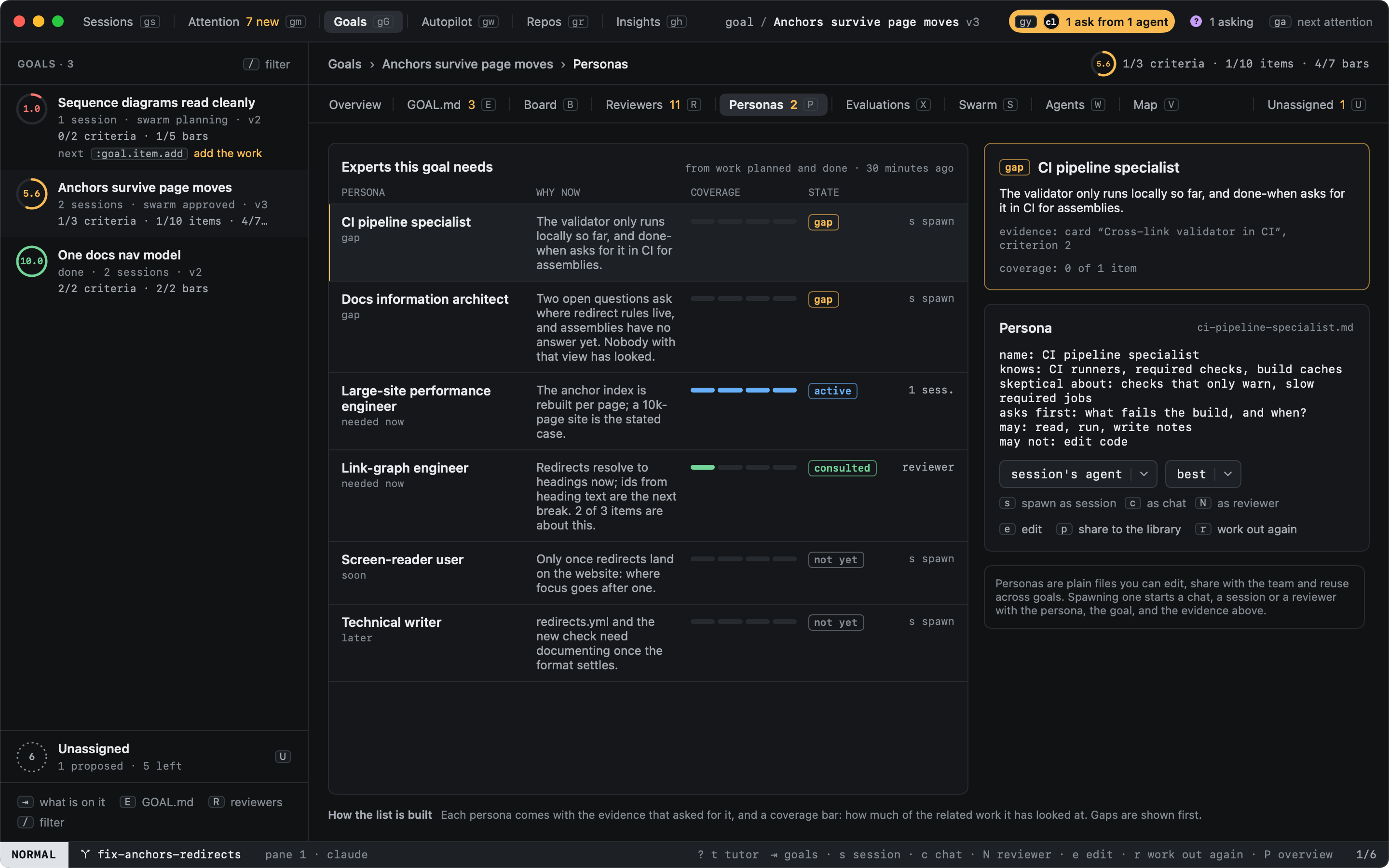
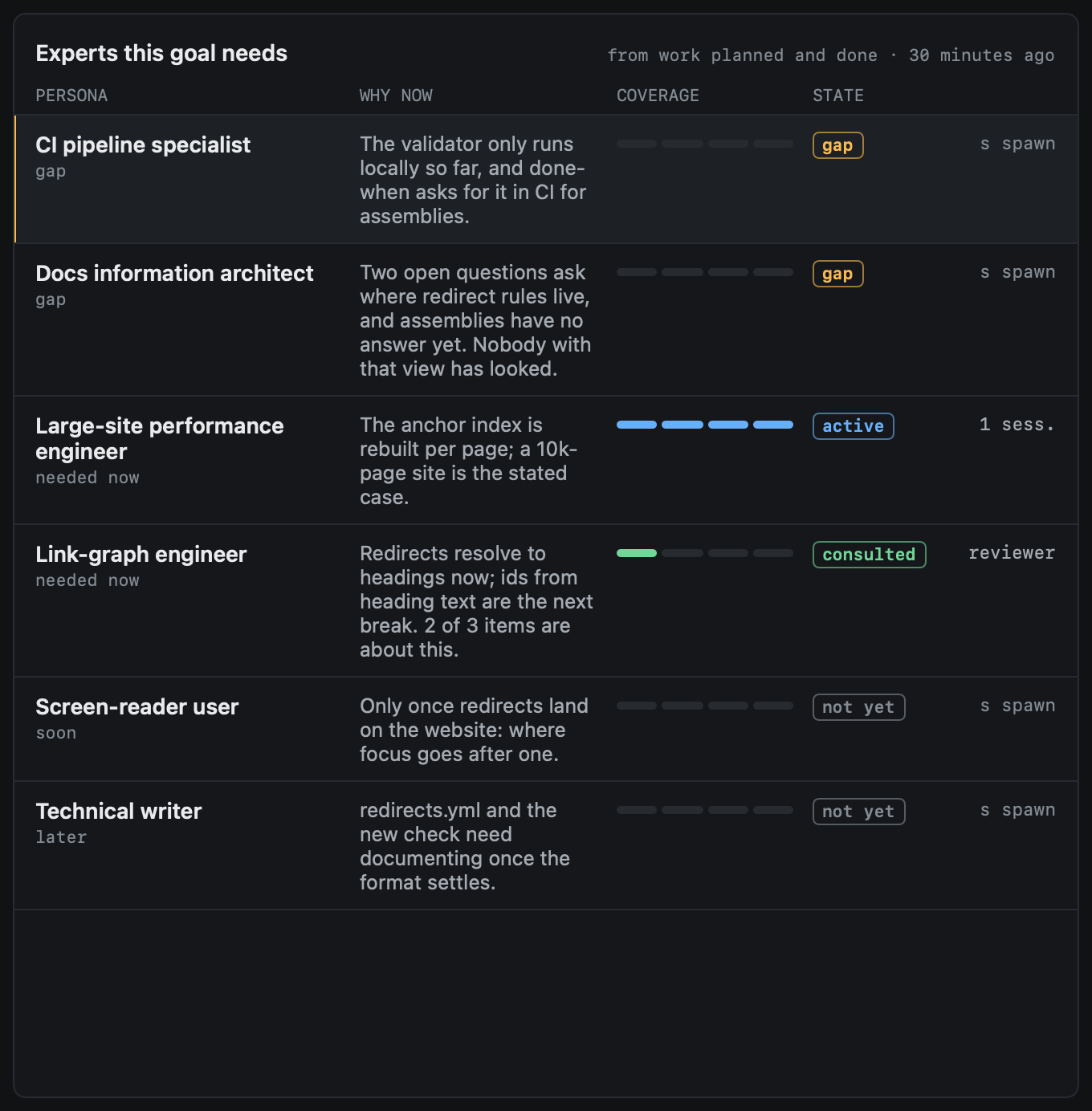
| Column | What it says |
|---|---|
| Persona | The persona's name, and when the goal needs it: now, soon or later |
| Why now | A sentence or two on why, from the board |
| Coverage | The share of the persona's items that a session, chat or review run with that persona has touched |
| State | gap, active, consulted or not yet |
The states, in the order the list shows them:
- gap: needed now, and the persona has looked at nothing it is about;
- active: a session or chat with the persona is open, or its reviewer is running;
- consulted: the persona has looked at some of its items;
- not yet: needed soon or later, and not looked at yet.
Gaps come first, then sooner before later, then the least covered. Coverage counts an item when a session or chat started as the persona is linked to the item. It also counts an item when a reviewer spawned from the persona (or a reviewer of the matching kind, such as the performance prober for a performance engineer) left evidence on it.
A cheap model reads the goal's GOAL.md and its board. It answers who is needed, when, why, and which items,
objections, criteria and open questions asked for each persona. heed drops any evidence the model names that is not on
the board. heed asks the model again when the board changes in a way that matters: an item added or done, an objection
raised or fixed, a criterion met, a question answered, something failing. A burst of changes is one ask: heed waits
until the board has been still for two minutes, and asks at most every fifteen. Each ask is one of the goal's model
calls for the day, shared with the planner and the proposer. r asks now.
Each persona is a plain file you can edit, share and reuse: personas/<name>.md in the goal's folder
(~/Library/Application Support/Heed/goals/<goal>/personas/). heed writes the file once, from the model's draft. After
that the file is yours, and a new derivation never writes over it.
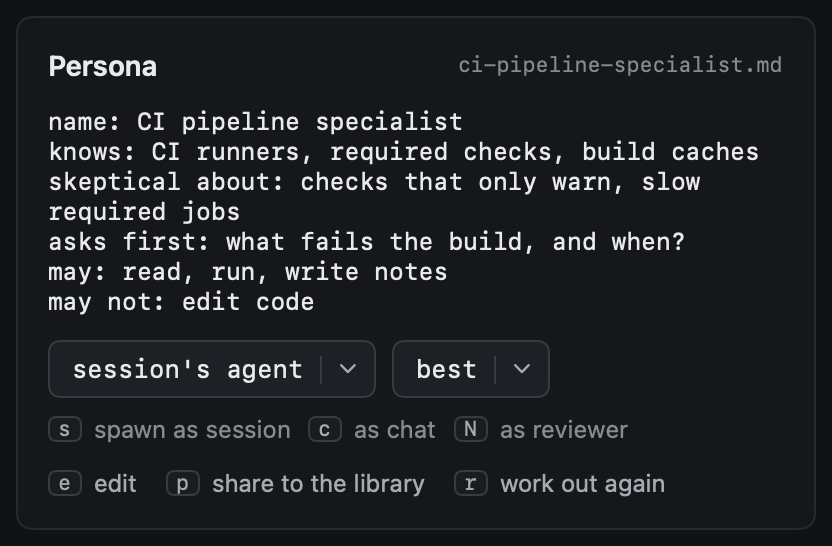
name: CI pipeline specialist
knows: CI runners, required checks, build caches
skeptical about: checks that only warn, slow required jobs
asks first: what fails the build, and when?
may: read, run, write notes
may not: edit code
Lists are comma separated; questions end at their ?. A value may go on over indented lines, or as - lines under
its key. heed keeps anything else in the file as notes and passes the notes on with the rest. e edits the file in
place; e again, ⎋ or ⌘S saves the file. A file whose name changes moves to the new name's file.
p copies (publishes) the persona into the shared library, ~/Library/Application Support/Heed/personas/, and
:persona.use <name> copies a persona from the library onto another goal. When the model names a persona the library
has, the goal gets the library's file instead of a new draft. heed offers or copies a library persona only when it is on
and in scope for the goal's repos. A persona scoped to another org is never offered. The library is Settings ›
Personas, where you add personas from your repos and choose what they join.
| Key | Spawns the persona under the cursor as |
|---|---|
s |
A session: Start work, filled in with the persona, the goal and the evidence |
c |
A chat, seeded the same way |
N |
A reviewer: read-only, in a worktree of its own, through the same machinery as the other reviewers |
The agent picker beside the keys chooses the agent for all three. The model picker applies to the reviewer; sessions
and chats start on the agent's own model. A session or chat started from here goes on the goal before its agent starts.
The agent therefore launches told about the goal (its GOAL.md pointer and heed's skills), like any session on a goal.
heed counts the session or chat as the persona's. A reviewer spawned from a persona shows under the persona's name in
Reviewers and scores like any other reviewer. heed tells the reviewer to review as that expert.
Everything also takes the mouse: a click picks a persona, and a right-click offers what the keys do.
A strong gap (needed now, with evidence that asked for it, and nobody with that view has looked) is spawned as a
reviewer without being asked, once per persona, while the goal's reviewer_runs_per_day lasts. heed suggests every
other gap, and strong gaps past the budget, instead: one Attention item per goal (persona gap). ↩ on the item opens
the goal's personas. auto_review = false in [goals] turns the spawning off; the suggestions stay.