
The summary
When a swarm is done (every task merged, in merge order), heed writes its end-of-build summary from the run's record,
and asks the lead to write its part. The summary is on the swarm's agents pane (W), on the goal's page, and in
History's ledger; its decisions go into GOAL.md.
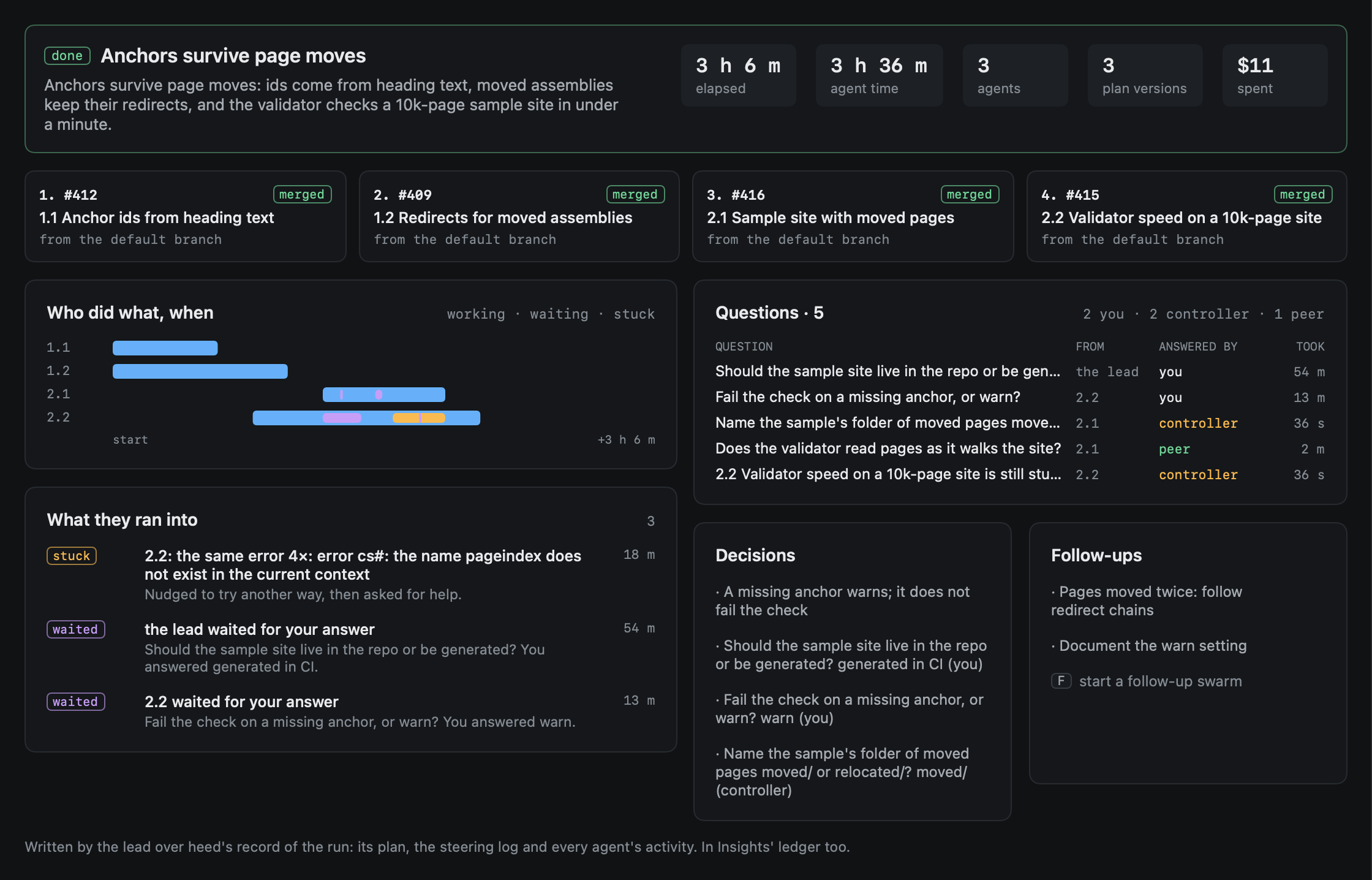
| Part | From |
|---|---|
| The outcome | The lead's words; until it writes them, heed's: tasks merged, PRs opened, how many stacked |
| Elapsed, agent time, agents, plan versions, spent | The run's record: from its first worker to its end, every worker's time and cost |
| The PRs | Each task's PR in merge order, its state, and what it stacked on |
| Who did what, when | A lane per task: its workers at work, its waits for an answer, its stuck stretches; the lead's acts |
| What they ran into | Stuck episodes (and how they ended), waits of five minutes or more for your answer, PRs heed could not move |
| Questions | Every question, who asked it, who answered it (you, the controller, a peer, the lead) and how long it took |
| Decisions | The lead's, then every answer you or the controller gave |
| Follow-ups | The lead's, then every question left unanswered |
When the swarm goes done, heed types into the lead's pane (once it is idle) that the summary is due:
heed swarm summary --outcome "Anchors survive page moves: ids come from heading text." \
  --decision "A missing anchor warns; it does not fail the check" \
  --follow-up "Pages moved twice: follow redirect chains"
--decision and --follow-up repeat. The newest summary counts; writing it again rewrites it everywhere. Only the
lead writes it. :swarm.summary assembles it again and asks the lead again.
- The goal's swarm:
Won a done swarm shows the summary first, and under it the agents as they were while it ran: each worker, the one under the cursor with its progress notes and activity (jkmove between them,sgoes to a worker's tab), and what changed since you last looked. - History's ledger: one entry per swarm, titled
Swarm: <goal>, with its PRs, agent time, spend, decisions and follow-ups (Lin History). GOAL.md: the lead's decisions are recorded under Decisions, as records (they apply at once and can be undone, like any decision an agent records).
F on the summary (:swarm.followup) opens the swarm form on the same goal with the last run's repos, lead, workers,
limits and stuck settings, and its follow-ups in the statement; ⌘↩ starts it. Its lead's first prompt says what the
last swarm ended with and the follow-ups it left. The new run is the goal's next swarm; the old one stays readable
with its plan, steering and summary.
"Same answer for similar questions" (A in Needs you) makes a repeat rule the controller answers with in every swarm
on the goal. The plan pane lists the goal's rules; :swarm.rule.delete <n> (or a right click on one) deletes it, as a
steering row: the controller stops answering with it.