
Heed's own model calls
Some of what Heed does needs a model for a moment: a summary, or a typed answer to a question about a session. Heed makes those calls itself, headless, through the agent CLIs you already use and are logged in to. There is no API key to set up: every built-in agent that is installed and logged in takes part, each with a cheap model, and they take turns, or the one you choose in Settings › Model calls takes them all.
| Agent | Login check (free) | Cheap model | Structured answers |
|---|---|---|---|
| claude | claude auth status |
haiku |
--json-schema |
| codex | codex login status |
the "fast and affordable" one in codex debug models |
--output-schema |
| gemini | none: a failed call says it | flash-lite |
read from the reply |
| opencode | opencode providers list |
the cheapest by opencode models --verbose, from a provider with credentials |
read from the reply |
| pi | pi --list-models |
a small one by name (haiku, flash-lite, mini, …) | read from the reply |
| cursor | cursor-agent status |
a small one by name from cursor-agent models |
read from the reply |
Custom agents take no part: Heed knows how to call each built-in headless, not an arbitrary command.
A call asks for a tier, and each agent's dialect says which model that is. cheap is what every call used until now
and is still the default; a feature that wants more reads says so (the session panel's look_model, see
Personas in sessions).
| Tier | claude | codex | gemini, opencode, pi, cursor |
|---|---|---|---|
cheap |
haiku |
the detected "fast and affordable" one | detected, as in the table above |
standard |
sonnet |
its own default, at medium reasoning (cheap calls keep it low) | its own default |
strong |
opus |
its own default | its own default |
Where heed knows no model for a tier it passes none, so the agent runs its own default, and the call's :log row says
so (tier: standard: no standard model known for codex, its own default); a model that was named shows as
tier: standard: sonnet. llm_model in [agents.<name>] replaces the cheap model only. The cache keeps a tier's
answers apart: the same call at another tier is a new call.
A tier above cheap still runs with tools off. A feature that needs a model to read the code asks for more than a tier:
the session panel's strong look runs your default agent headless and read-only in the session's worktree instead, the
way the goal wizard's plan does, on claude's opus.
- Summaries: where a piece of work stands, written from its git history, its pull request, Heed's timeline and the
agent's last message, and a handoff brief for an agent taking work over. Heed's prompts for them are built in; add
your own with
summary_instructionsin[pilot], per org or per repo, like the other instructions. - Decisions: typed questions about a session or a PR (pick one of some options, place it on a scale, or how
likely something is true), answered with probabilities and a confidence. Each one writes a
deciderow in:logwith what it was about, so what you do next can be compared with it. The confidence is the model's own and uncalibrated: Heed never takes an action that cannot be undone on it.
Today they write the ledger's summaries, and in Attention a
catch-up summary of what is new in a thread since you last looked
(ahead for New, on open for the rest, per [attention] summaries), a drafted reply (shown in full before anything is posted) and a suggested weight for items no
rule matched. With [llm] enabled = false, none of that happens and the rest of Heed
works as before.
- In an empty temporary directory, removed afterwards, with the agent's tools off and its session not saved
(claude:
--tools "" --no-session-persistence --setting-sources "", and a short--system-promptof Heed's own; codex:--ephemeral -s read-only; pi:--no-session --no-tools; cursor:--mode ask; gemini:--approval-mode planand a policy file of Heed's that denies every tool; opencode: anopencode.jsonin that directory that denies every permission). gemini and opencode get the text on stdin, not on their command line. - By the agent's executable as Heed found it, the first word of its
command, without your shell: an alias or a shell function of that name does not apply here (in panes it does). When detection does not find it, set[tools] pathor the agent'scommandto where it is. - With a timeout (
timeout_seconds), a few at a time (concurrency), the calls you asked for before background ones. - Once: an identical call (the same instructions, input and schema) is answered from a cache while Heed runs.
With [llm] agent = "claude", that agent takes every call alone, and a call it cannot take fails. Otherwise
("auto", or not set) the usable agents take turns. An agent is skipped while:
- it is turned off (
[agents.<name>] llm = false), - it is rate limited in one of your sessions, until its limit resets when that is known,
- one of its calls failed in the last
backoff_minutes, or said it hit a limit (until the reset it named), - it reached its daily cap (
daily_calls,daily_dollars): background calls then wait until tomorrow, while the ones you ask for still run, - it is not installed or not logged in.
Every call writes an llm row in the call log (:log): which agent took it, the model, the
tokens and cost when known, the prompt and the answer, and why the agents before it were skipped. A call that could not
run at all writes a row saying why, so background work that waits on the cap shows there.
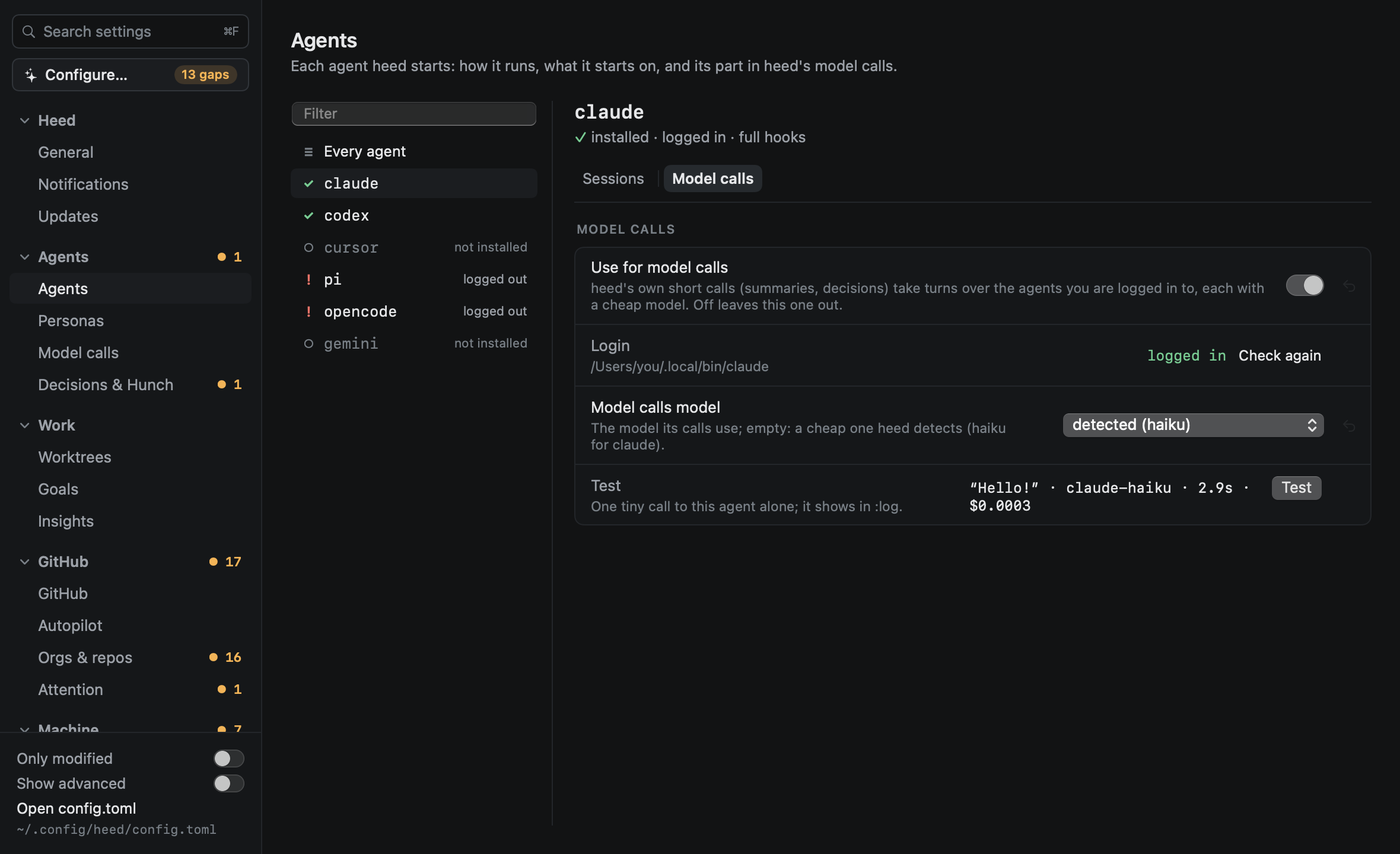
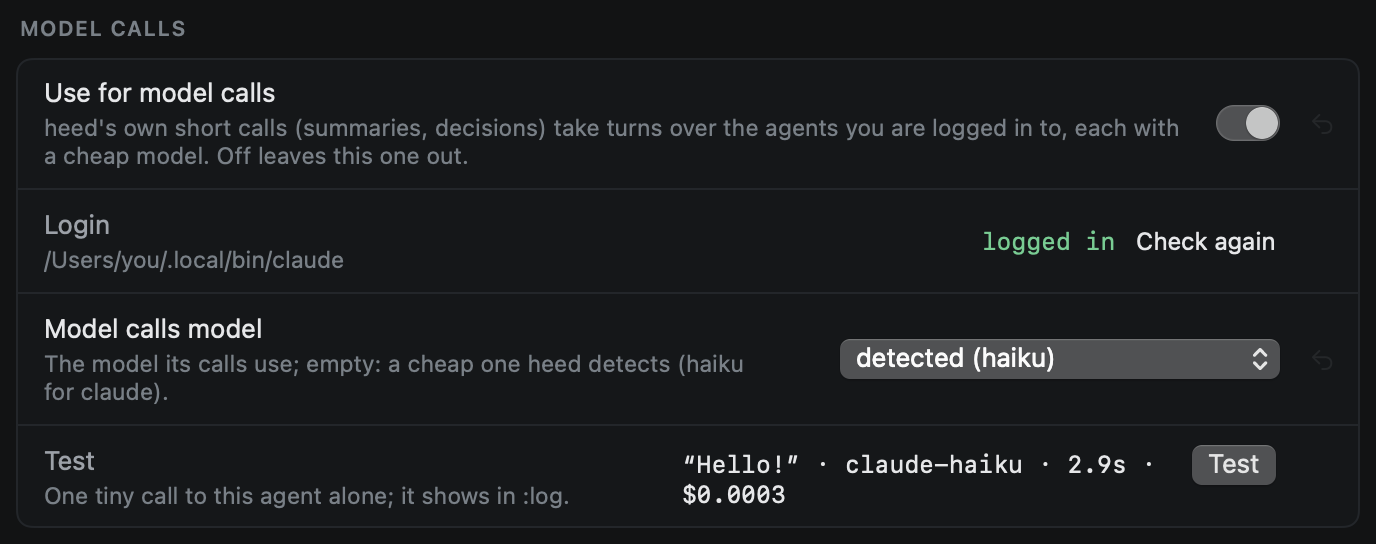
Settings › Agents, on each agent's Model calls tab, shows whether it takes part, whether it is installed and logged in, the model it uses
(empty: the cheap one detected), and a Test button: one tiny call to that agent alone, with its answer, how long
it took and what it cost. The test shows in :log like any other call. Below the agents, Model calls, every
agent holds the [llm] settings: the switch that turns every model call off (and back on), the timeout, how many run
at once, the back-off after a failure, and the daily caps.
The same in config.toml:
[llm]
enabled = true
timeout_seconds = 120
concurrency = 2
backoff_minutes = 10
daily_calls = 100
daily_dollars = 1.0

[agents.codex]
llm = false
[agents.claude]
llm_model = "sonnet"
- false: Heed makes no model calls at all
- per agent per day; 0: no cap
- per agent per day, where a cost is known; 0: no cap
- leave this agent out
- instead of the detected cheap model
A cost is known when the agent reports one (claude, opencode, pi) or [usage.prices] has a price for the model.