
Attention rules
Rules decide what counts more, what counts less and what does not count at all. They live in config.toml, one rule
a line, and the first rule that matches an item decides what happens to it:
[attention]
rules = [
  "mention user:me                boost 3",
  "review requested:me            boost 2",
  "mention team:acme/docs-eng     boost 2",
  "mention team:acme/docs-all     lower",
  "mention team:acme/everyone     ignore",
  "author bot:dependabot          ignore",
  "label \"blocker\"                pin",
  "repo acme/*-archive            ignore",
  "agent blocked|asking           boost 3",
  "ci branch:main                 lower",
]
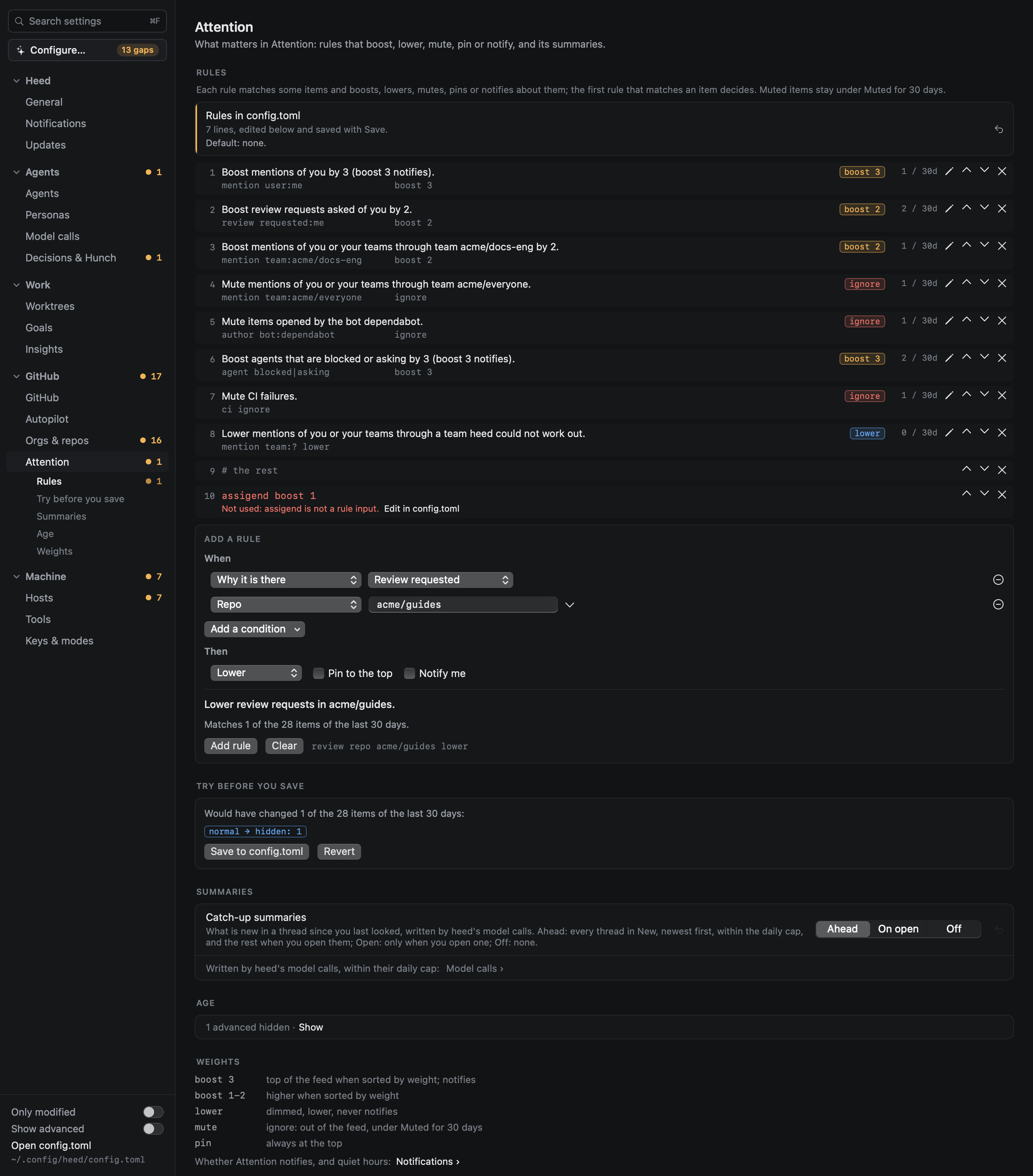
Settings › Attention (:settings.open attention) lists the rules in order, each in plain words ("Mute items opened
by the bot dependabot.") with the line it is in config.toml and how many items of the last 30 days it decided. Move
a rule up or down (the first match wins), change it, or remove it (Undo brings it back). Before you save, it shows
what the edited rules would have changed over the items of the last 30 days.

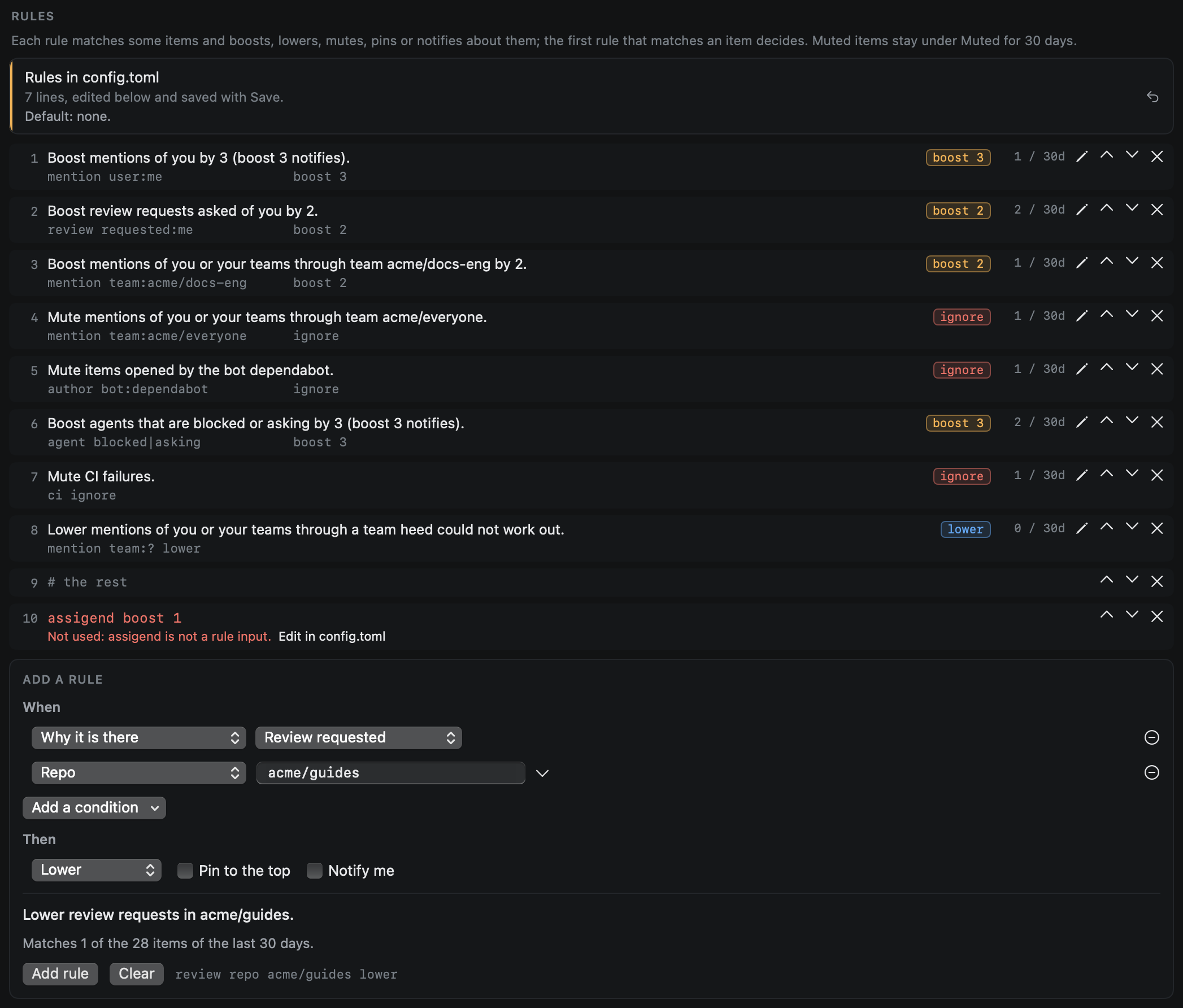
Add a rule builds one from choices, so a rule heed cannot read never gets into the list:
- When: add conditions from the menu (why it is there, repo, opened by, label, team, agent state, what it is, draft or ready, lines changed, last update, whose turn, CI branch). Each is a kind and a value; a value is typed only where it has to be (a repo, a label, a login, a branch), and the arrow next to it offers the ones heed has seen. No conditions means every item, and says so.
- Then: a weight (boost 1-3, keep, lower, mute) and two switches, pin and notify. Mute takes no other action.
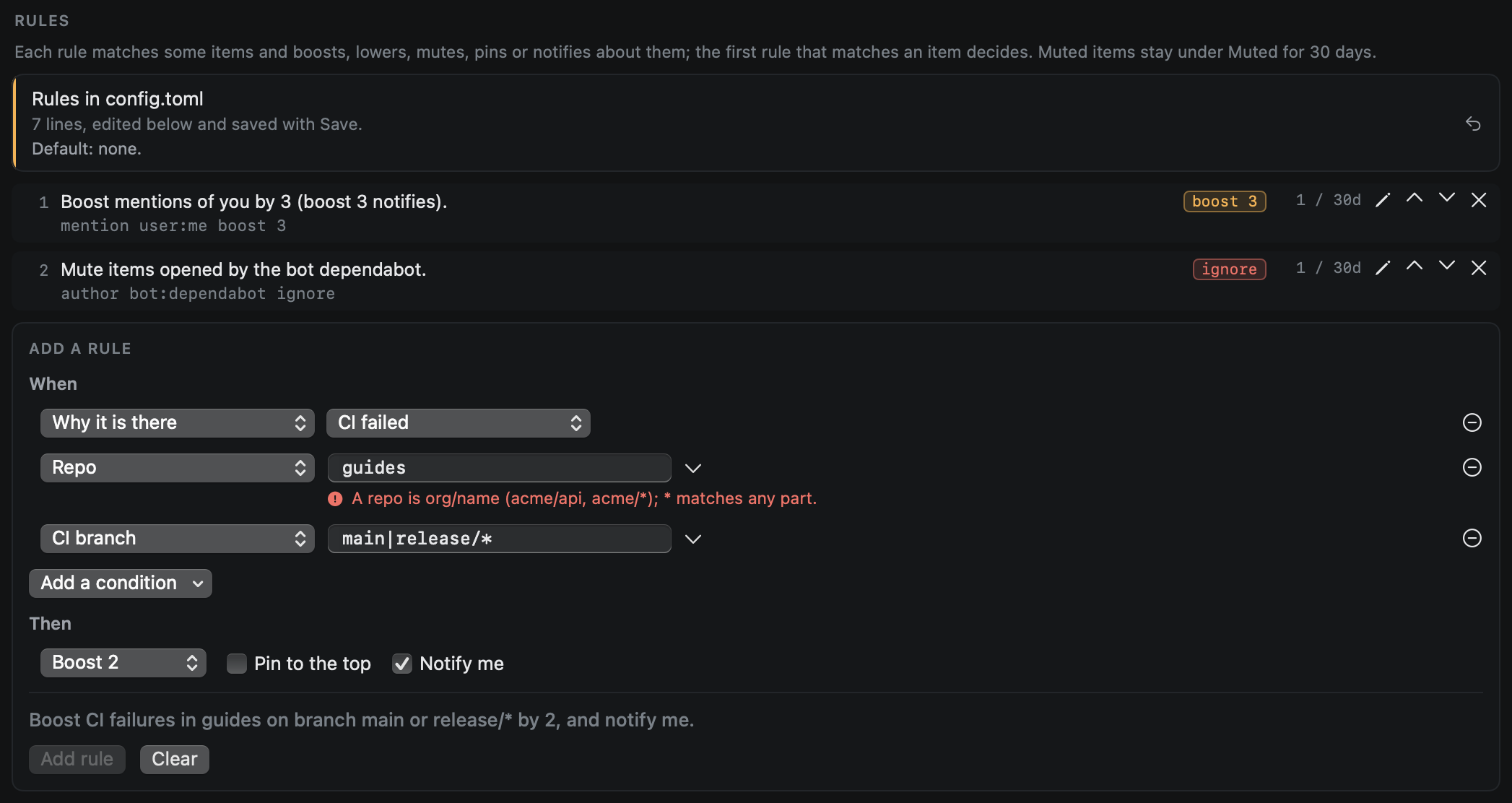
A value is checked as you type, with the reason under it: a repo is org/name (or a glob with *), no spaces or
quotes, no empty choice around |. Conditions that can never hold together (draft and ready, more than 500 and
fewer than 100 lines) are refused, and so is a rule that repeats another or matches exactly the items another
already decides. Add rule stays off until the rule is fine. Under it, the rule in plain words and how many of the
last 30 days' items it matches, in amber when that is most of them.
The file stays the source: the editor writes rules in the syntax below, and a line you have not changed is saved
exactly as it was written, spacing and # comments kept. A line the editor cannot build, or one that does not parse,
is shown as written with Edit in config.toml; it is never dropped. A line that does not parse is also reported in
the status bar with its number and left out; the other rules still apply.
| Action | |
|---|---|
boost 1, boost 2, boost 3 |
Higher when sorted by weight; boost 3 also notifies |
lower |
Dimmed, lower when sorted by weight, never notifies |
ignore |
Out of the feed: listed under Muted, and kept there for 30 days |
pin |
At the top of the feed |
notify |
A notification when it arrives; combines with the others (boost 2 notify) |
notify and boost 3 post a macOS notification when the item arrives.
For an item no rule matched, heed's Decider may suggest a weight, shown next to the item
and never acted on. What you do with items (done, snooze, mute) is kept beside those suggestions in the call log, for
a better ranking later.
Quiet hours are a setting, not a rule: [attention] quiet = "22:00-08:00".
Every condition on a line must hold. Values take globs (*, ?) and alternatives (blocked|asking), and match
case-insensitively.
| Input | Matches |
|---|---|
mention |
You or one of your teams was @-mentioned, mentions from before included |
user:me |
You yourself were mentioned, and lately (mention user:me): a mention from before does not match, so mention user:me boost 3 leaves the old ones folded |
team:acme/docs-eng |
It came through that team: the team mentioned, or asked to review. team:? matches a team mention whose team heed could not work out |
review |
A review was requested; requested:me of you yourself, requested:team of one of your teams |
assigned |
Assigned to you, assignments from before included |
ci, mine, changes, threads, mergeable, comment, subscribed |
The reason it is there: CI failed, your PR, changes requested, unresolved threads, ready to merge (with merging off), ... |
agent blocked\|asking\|limited |
An agent in one of those states; agent alone, any agent |
proposals |
A goal with changes to its GOAL.md waiting for you (Goals) |
author maria, author me |
Who opened it |
author bot, author bot:dependabot, author human |
Opened by a bot (that one), or by a person |
label "blocker" |
A label |
repo acme/*-archive |
The repo |
branch:main |
The branch a CI failure is on |
kind pr\|issue\|ci\|release\|discussion\|agent\|goal |
What it is |
draft, ready |
A draft PR, or one ready for review |
size >500, size <50 |
Lines changed |
age >7d, age <2h |
Time since its last update (m, h, d) |
turn mine, turn theirs |
Whose turn: someone else spoke last, or you did |
reason teamMention |
Any of heed's reasons by name |
any |
Everything (a last line that catches the rest) |
GitHub says a notification is a team mention but not which team. Heed works it out for each new team mention with a search in that repo per team you are on, and falls back to reading the thread; a review request asks the PR which teams were requested. Each thread is worked out once (until its reason changes), so this costs about one call per new team mention.
It needs gh's read:org scope to list your teams. Without it there is no team attribution and every team mention
matches team:?; gh auth refresh -s read:org adds the scope.