
Audit
A in Insights (or :audit, history.audit) shows what heed and your agents did outside this Mac: every push,
merge, comment, review and publish, newest first, each with what caused it. Its tab counts the actions of the last 7
days. A again goes back to the dashboard.
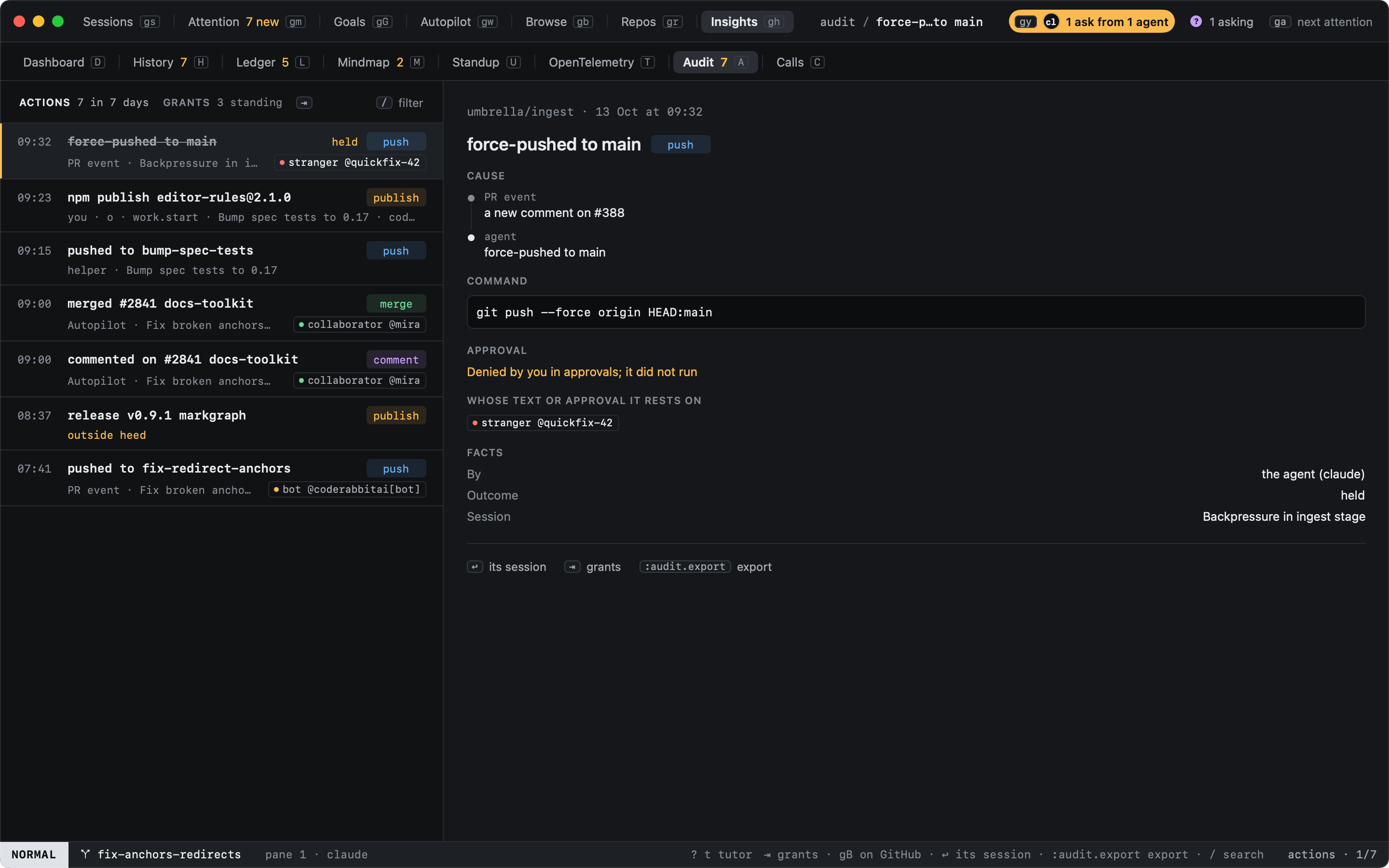
One row per action: the time, what it did, its class, and the cause.
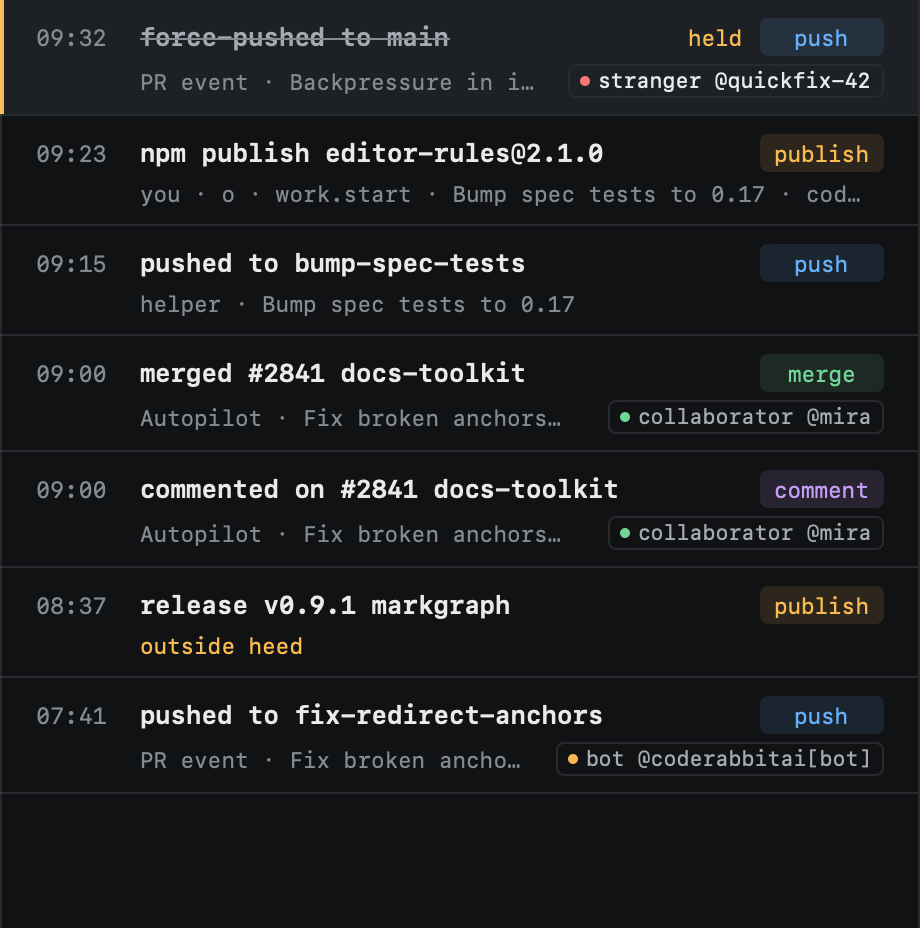
| Class | |
|---|---|
publish |
A release, a package published, a tag pushed, a deploy: what the approvals tag as publishes |
merge |
A PR merged |
push |
Commits pushed, a branch deleted on the remote |
comment |
A comment on a PR or an issue |
review |
An approval, a review, reviewers asked for |
write |
Any other change on GitHub: a PR opened, closed or edited |
Reading, fetching and marking notifications read are not actions, and are not listed.
Audit records three kinds of action:
| By | From |
|---|---|
| heed | Every GitHub write heed makes through gh (merges, comments, reviews, reviewers, Copilot), and every git push it runs (a helper's close-out) |
| The agent | The agent's tool calls its hooks report: a shell command that pushes, writes to GitHub or publishes, and GitHub tools that write |
| Outside heed | A release or deployment on a repo heed watches that no recorded cause explains |
heed reads releases and deployments with gh api (read only) every 30 minutes, for the repos of your sessions and
recent history. A release counts as explained when heed or an agent published in that repo shortly before: a command
that names its tag, a tag pushed, a workflow run. A deployment counts as explained by a publish or a merge there.
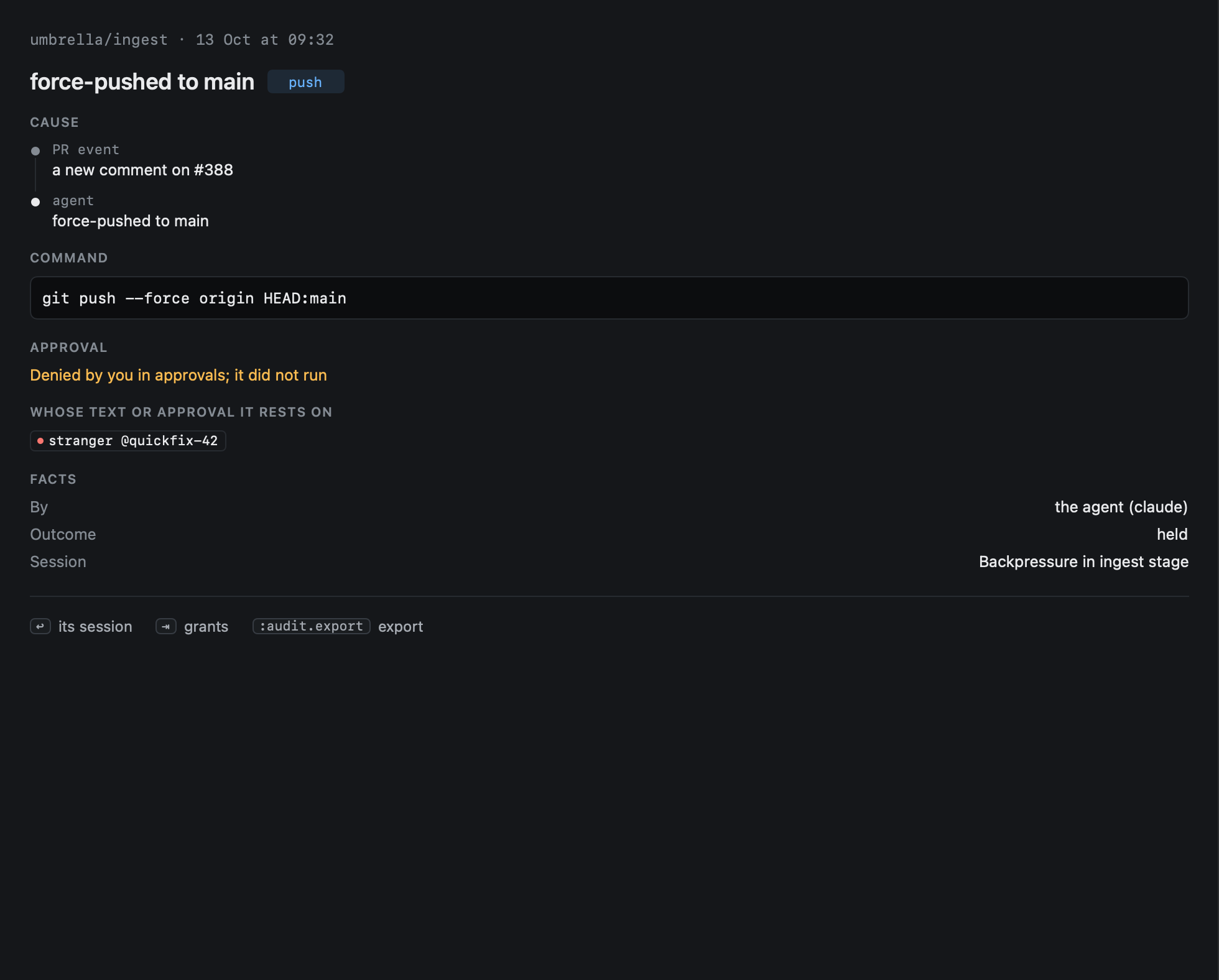
heed makes a cause where it starts something, and the work carries it:
| Trigger | |
|---|---|
| You | A key or a command you ran (zM · pilot.merge.now) |
| Autopilot | A rule decided: a merge when every rule held, with the approvals it merged on |
| Helper | A helper heed started on a PR, and its close-out |
| PR event | Feedback heed sent on its own when it arrived on a PR |
| Session | The session or run the action happened in, and the prompt heed gave its agent |
Agents' panes carry their cause in HEED_CAUSE, so their hooks name it with each tool call. When heed told Claude's
auto mode where a tool result came from (Hooks), that note is a step
of its own in the chain, "Told auto mode: …", above what the agent in that pane does next.
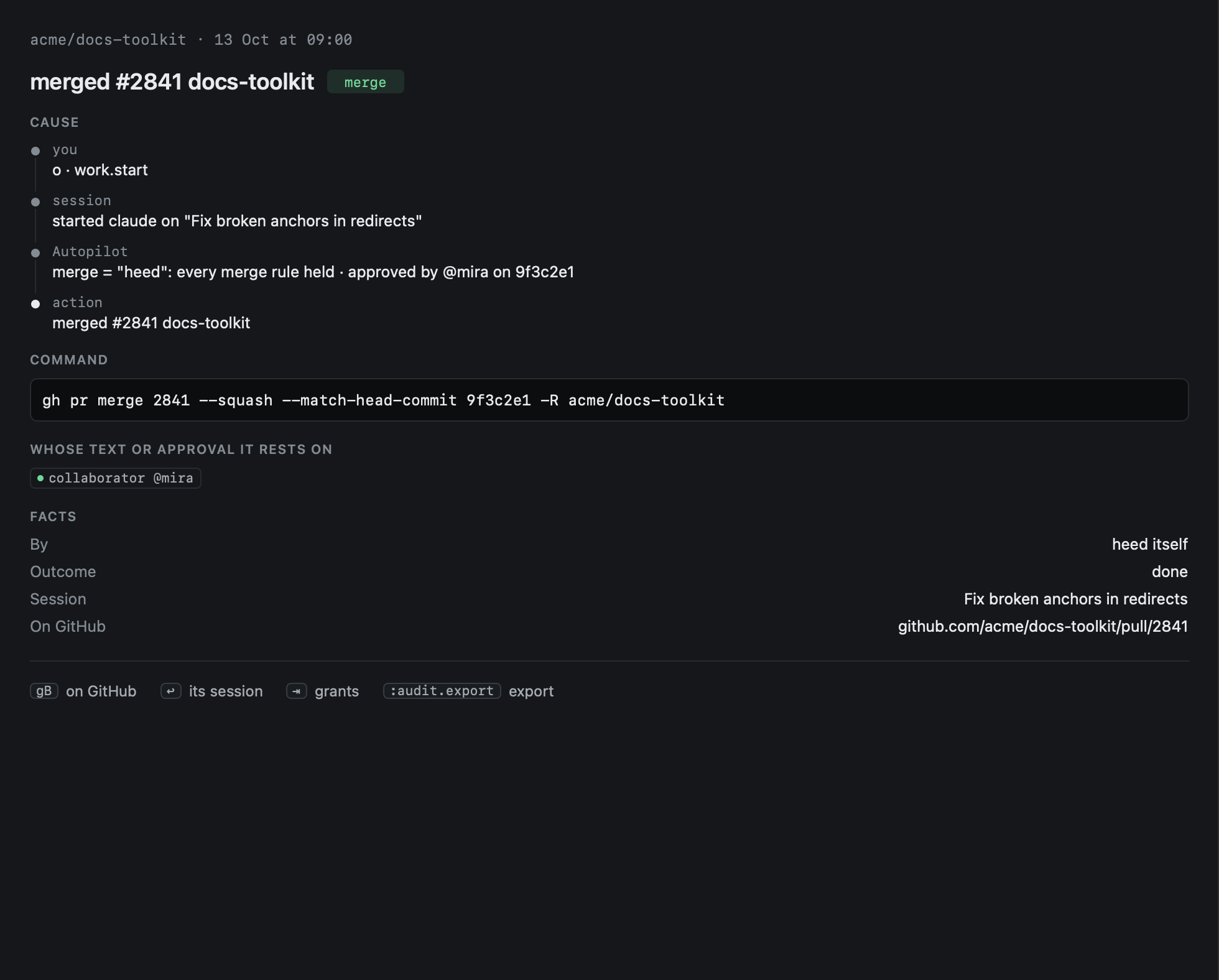
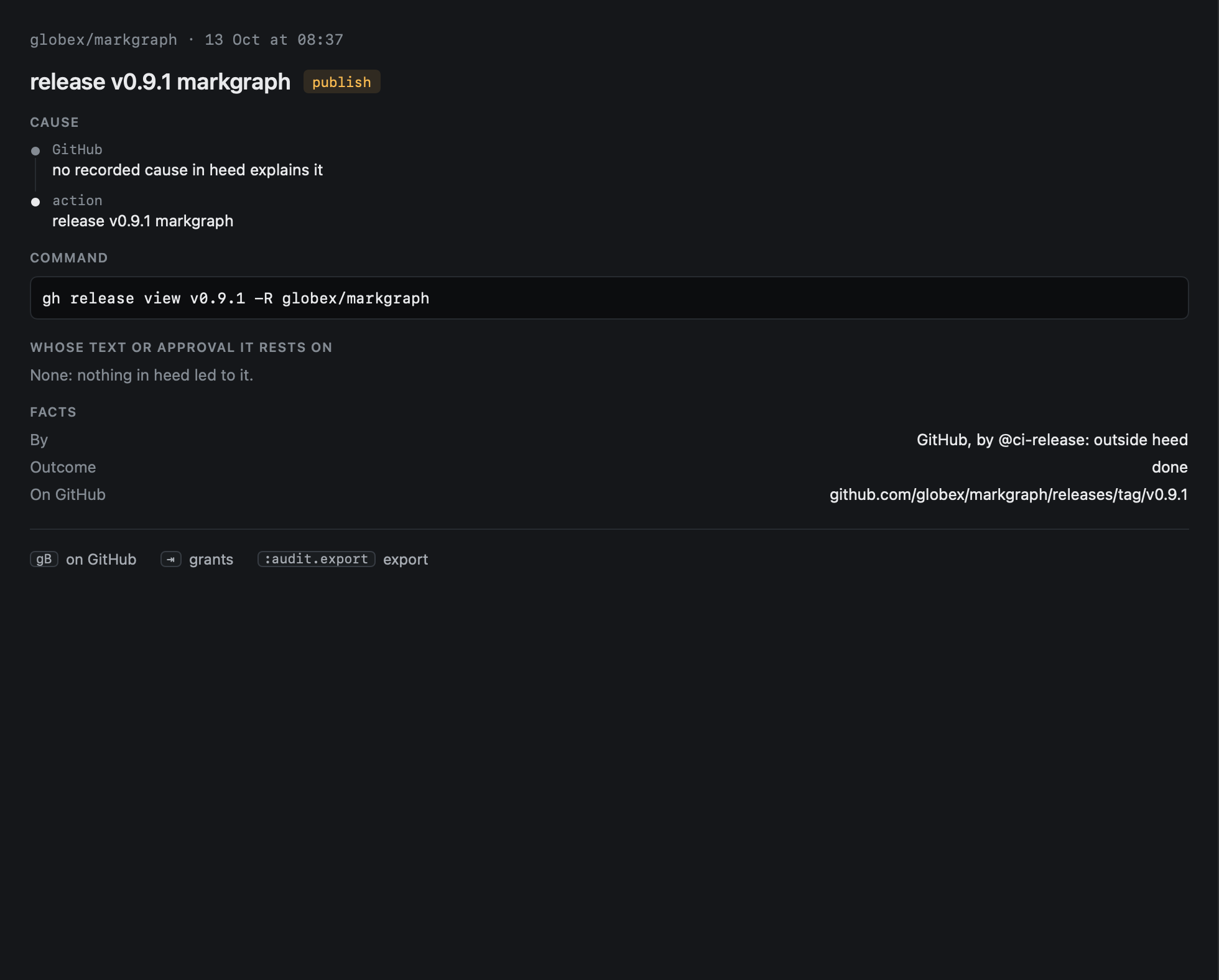
The detail shows:
- the cause chain, from the trigger down to the action;
- the exact command;
- the approval: allowed or denied by you in the approvals (
gy) or from a notification, or allowed without asking heed (an Always rule, the agent's own mode); - whose text or approval it rests on: the text that reached the prompt heed built for that session or run (a review comment, a PR's body, a check's output), or the approvals an Autopilot merge went on, with how far heed trusts each author: owner, collaborator (who can write to the repo), organisation member, bot or stranger.
A push you denied shows as held, struck through.
| Key | |
|---|---|
j k |
Move through the actions |
gB |
Open the action on GitHub |
↩ |
Go to its session (audit.session) |
⇥ |
The grants, and back (audit.grants) |
/ |
Search what, the command, the repo, the session and the authors |
:audit.export |
Write the record to a JSON lines file you pick |
⇥ lists what heed gave for good, newest first:
| Grant | Revoking it |
|---|---|
| Always rule | Takes the rule out of the project's .claude/settings.local.json. The agent asks again |
| Claude trust | Sets hasTrustDialogAccepted to false for the repo in ~/.claude.json |
| mise trust | Runs mise trust --untrust in the repo |
| Trusted reviewer | Takes the login out of the repo's trusted_reviewers in config.toml |
| Memory | Drops a decision an agent proposed and you kept in the Mindmap |
| Helper Always | A helper's agent keeps it for its own run, which ends with it: nothing to revoke |
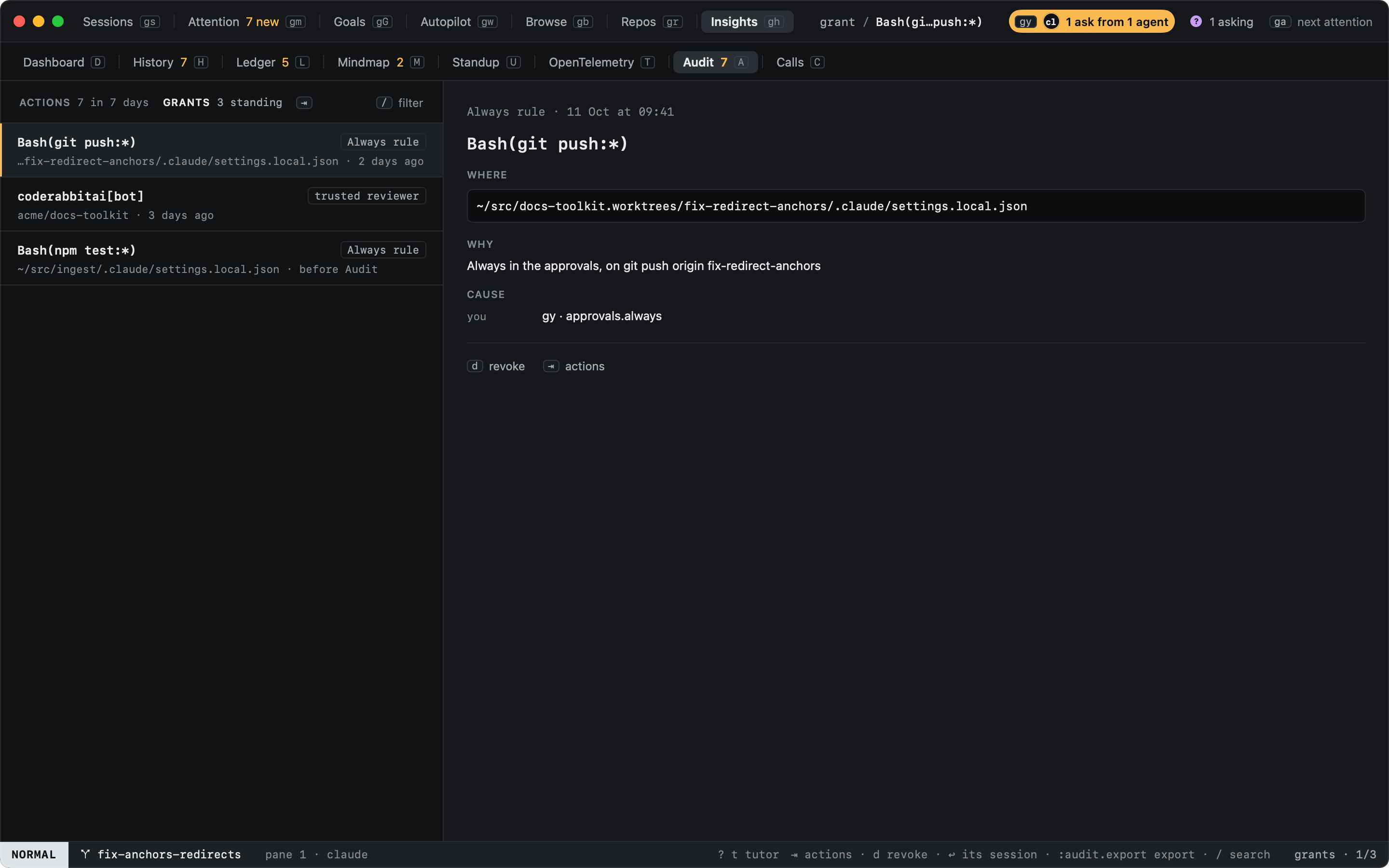
Each grant says when, why and by which cause. Audit records grants from the time it started. Always rules already in
the settings.local.json of the repos and worktrees heed knows are listed too, marked "before Audit".
d revokes the grant under the cursor (audit.revoke), after you confirm. While heed is at it, the grant is marked
revoking, and d again does nothing. When it is done, the grant stays in the list, marked revoked, with what heed did.
When heed could not take it back (a file it cannot write, mise failing), the grant is marked not revoked with the
reason, still stands, and d tries again.
Audit keeps its record in heed.sqlite on this Mac, for a year. It only adds rows. Each row holds the SHA-256 of the
row before it, and of its own place in the record, its time and its content, so a row that changed or went missing in
the middle breaks the chain. Where the record starts and ends is kept apart, in heed.audit.json beside
heed.sqlite, so Audit also notices rows missing from the start or the end of its record, or an older copy of
heed.sqlite put back. When pruning drops the rows past a year, it notes the last row it dropped there first, so the
first row left still has something to follow; it never drops a row that does not hold, so a row whose time was changed
to make it look old stays, and shows.
The record has no key: Audit notices rows that changed or went missing, but anything that can write to your files could write a whole new record and its note alike.
When the chain breaks, Audit says at which row, and why, under its header. When a row could not be written to
heed.sqlite (the disk full, say), Audit says how many are waiting and why; they are shown, and heed writes them with
the next row. Audit never notifies you and never takes focus.
Rows written before heed covered a row's place and time keep verifying as they were, and heed checks that their time is still the one their content says; rows written since are in the new form.
:audit.export writes the whole record as JSON lines: one row a line, oldest first, with its place in the chain
(seq, prev, hash), the form of its hash (v), its time (at, seconds since 1970) and its content (body),
exactly as it was hashed: jq '.body | fromjson' reads it. A row of form 2 hashes, as SHA-256 in hex, the lines 2,
prev, seq, at in whole milliseconds, kind and body, joined by newlines; one of form 1, the lines prev,
kind and body. The first row follows 0 × 64 (the start of the record), or the last row pruning dropped.