
How work finds its goal
You do not have to put work on a goal. When a session or chat starts, gets its first prompt, tracks a PR, or gets a ledger entry, heed looks for its goal. When it is sure, it attaches the work and says so, with undo. When it is unsure, it asks you once, one key. Otherwise it leaves the work alone, in Unassigned.
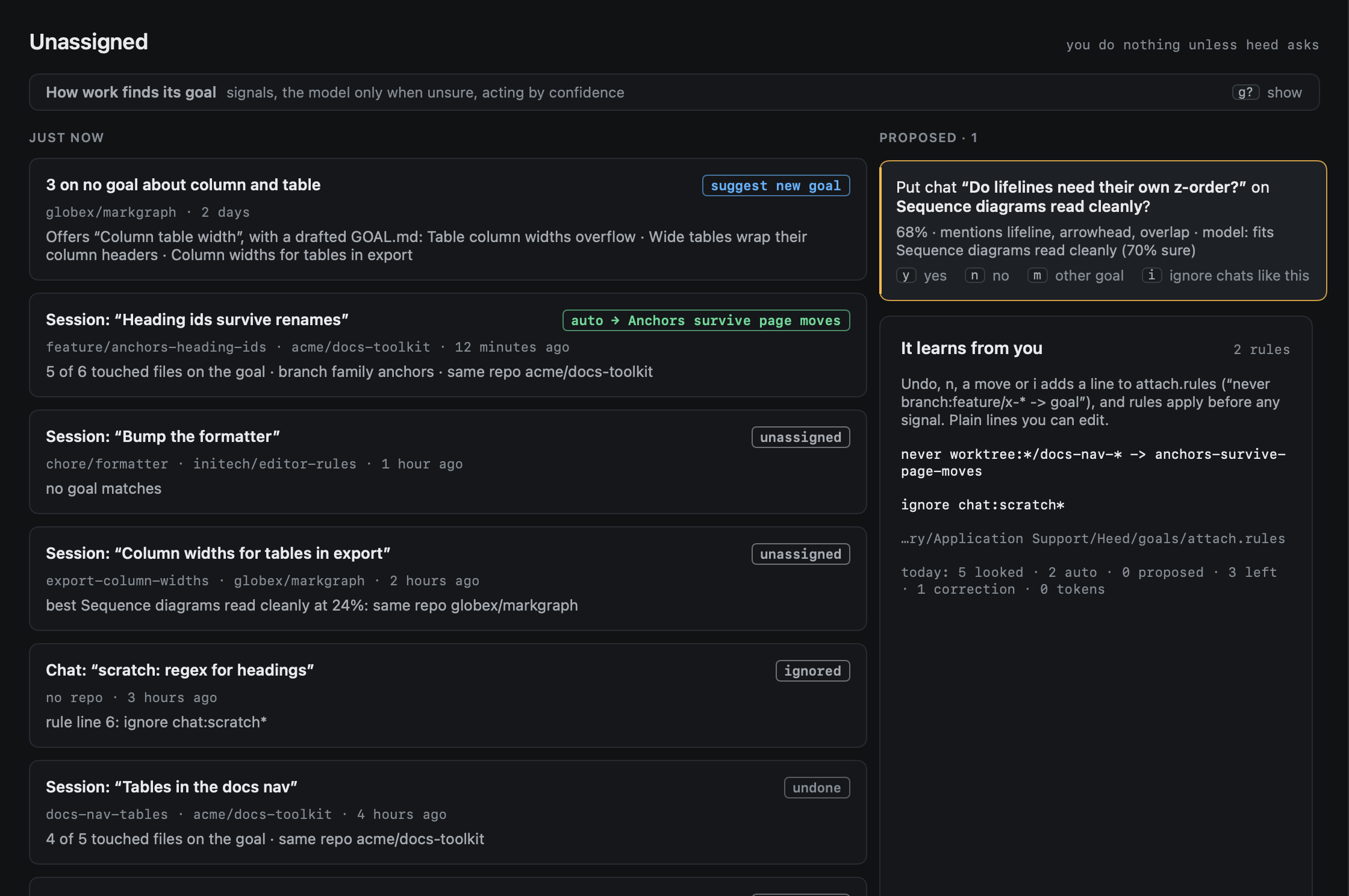
U in Goals (or :goal.unassigned) opens Unassigned: what heed decided lately and why, what it asks, goals it
suggests, and what it learnt from you. While nothing waits for you there (no ask, no suggested goal), the three steps
below show on top of it, as cards; otherwise they fold to a line, so what needs you comes first. g?
(:goal.unassigned.how) shows or hides them either way.
heed compares the new work with each active goal and what is already on it:
| Signal | Weight | |
|---|---|---|
| Same worktree | 0.9 | a worktree folder something on the goal works in |
| Same branch | 0.85 | not main or another default branch |
| Branch family | 0.65 | feature/anchors-redirects and anchors-validator share anchors |
| Linked PR | 0.9 | one of its PRs is on the goal already |
| Linked issue | 0.8 | |
| Files touched | 0.8 × share | the share of the files it touched (from its ledger entry) already on the goal |
| Prompt terms | 0.6 × share | the share of its title's and prompt's words, rarer words weighing more, that the goal's GOAL.md has (never its Not the goal list) |
| Same repo | 0.15 | |
| Goal active lately | up to 0.1 | in the last 48 hours; only adds to another signal |
Signals add up as independent evidence: confidence is 1 − (1 − w₁)(1 − w₂)…, so two middling signals make a strong
one, and no pile of weak ones reaches certainty. Work in repos the goal has never seen counts for 60% of that.
When the best goal is between attach_ask and attach_auto, or two goals are within 0.1 of each other, heed asks a
cheap model (Agents › Model calls): the goals with their statements and Not the goal lists, the work, and what the
signals saw. It answers with a goal or none, how likely each is, and how sure it is. The call is in the call log
(:log) as a decide with subject goal-attach:session:<id>.
The answer moves the number; it never replaces it. Each goal's confidence becomes (1 − w)·signals + w·model, where
w is 0.6 times the model's own confidence. A goal no signal found is never picked, and a model sure of "none" can
push the work back to Unassigned. With model calls off, or attach_model = false, the signals decide alone.
| Confidence | What heed does |
|---|---|
attach_auto (0.85) or more |
Attaches it, says so in the status bar; u in Goals (:goal.attach.undo) undoes |
attach_ask (0.5) to attach_auto |
Asks, once: an item in Attention (reason which goal?) and in Unassigned |
below attach_ask |
Leaves it in Unassigned |
Two goals within 0.1 of each other are always asked about, however sure.
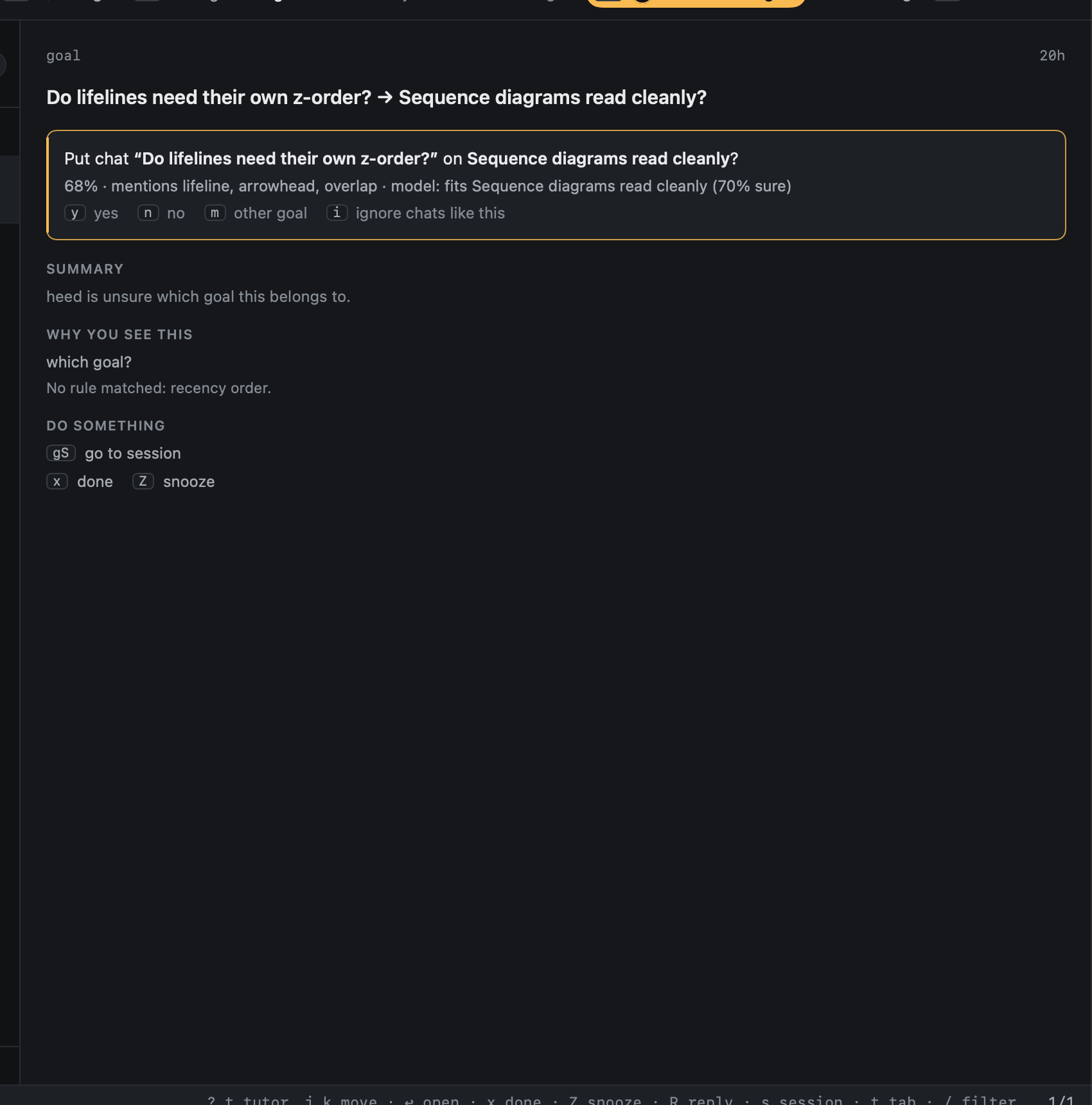
In Attention and in Unassigned, one key answers:
| Key | |
|---|---|
y |
Yes, on that goal |
n |
No, not that goal; it stays unassigned |
m |
On another goal (⇥ completes the goal) |
i |
Ignore things like this: no goal, no ask |
In Attention, m on anything that is not an ask still pins, as before. The rule keyword attach matches asks in
[attention] rules, so attach notify gets you a notification for each.
An undo, an n, a move off the goal heed picked, and an i each add a line to
~/Library/Application Support/Heed/goals/attach.rules, under a comment saying why:
# 2026-10-26: you undid Tables in the docs nav on anchors-survive-page-moves
never worktree:*/docs-nav-* -> anchors-survive-page-moves
ignore chat:* repo:acme/docs-toolkit
The file is yours to edit. Each line is a verb, conditions (all must hold) and, for always and never, a goal:
| Verb | |
|---|---|
always … -> goal |
Things like this go on the goal, without asking |
never … -> goal |
Things like this never go on the goal |
ignore … |
Things like this stay on no goal, and are never asked about or suggested |
Conditions are field:glob (* any run, ? one character, a|b either; case does not matter; quote a pattern with
spaces: title:"fix the build*"). Fields: worktree (its full path), branch, repo (org/name), chat and
session (by title, only that kind), title (either), prompt.
Rules apply before any signal, in file order: the first ignore or always that matches settles it, and every never
that matches takes its goal out. A line heed cannot read is skipped and shown with its number (in Unassigned and in
Settings › Decisions & Hunch); the others still apply. heed learns "like this" as the work's worktree family, else its branch
family, else, for a chat, chats (in its repo).
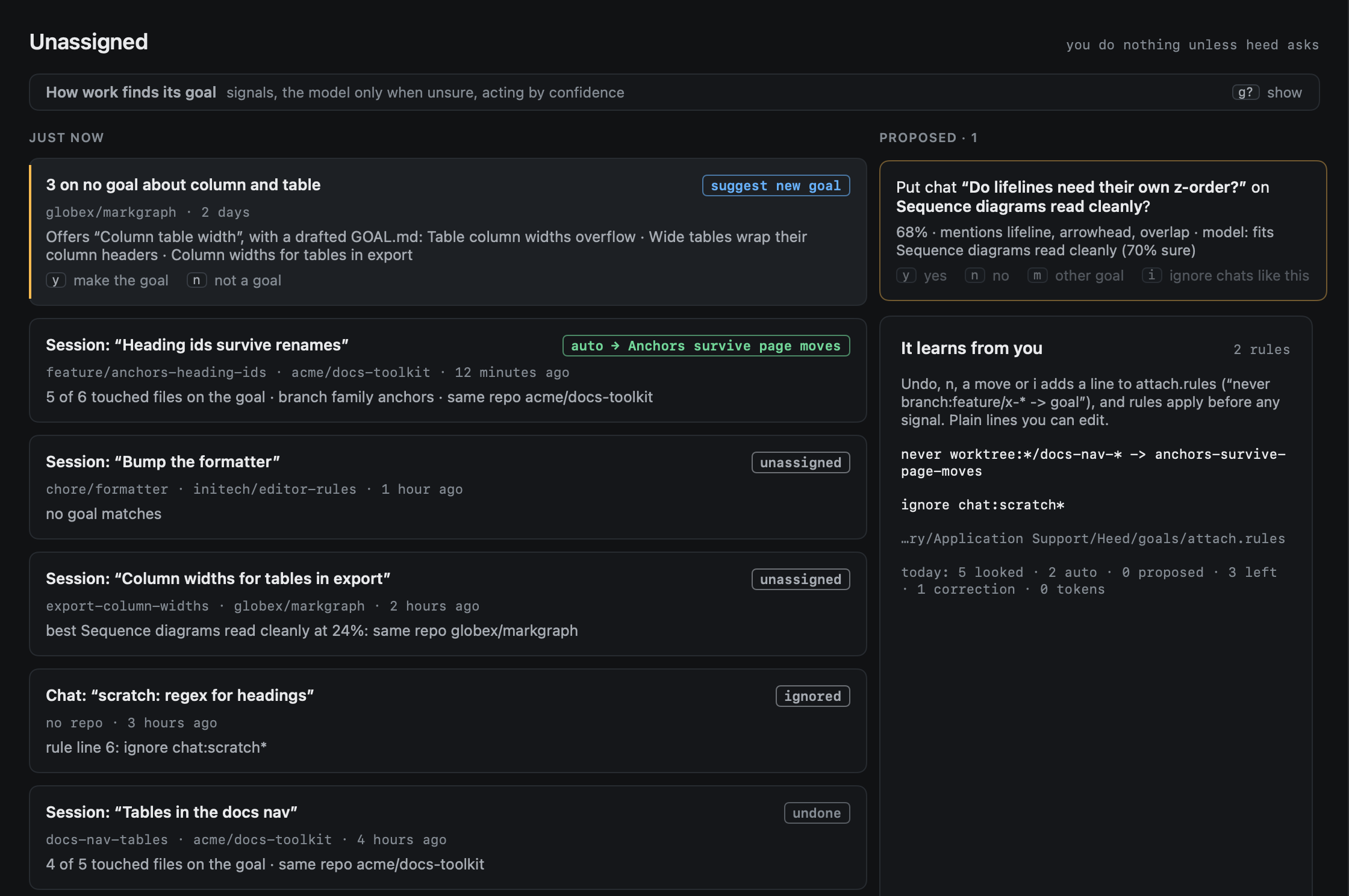
Work left on no goal that hangs together becomes a suggestion: three or more sessions or chats in one repo, each
sharing at least two words with another, within a week. y on it has the model draft a GOAL.md from their titles
and prompts (a plain draft when model calls are off), makes the goal, and puts the work on it. n drops the
suggestion.
The bottom of It learns from you counts today: things heed looked at, attached on its own, asked about, left on no goal, your corrections, and the model tokens it spent.
Settings › Decisions & Hunch › Finding new work's goal turns finding goals on and off, sets the two thresholds and whether the model is asked
(these three are advanced: turn on Show advanced, or search for attach), and opens attach.rules. In config.toml:
[goals]
attach = true
attach_auto = 0.85
attach_ask = 0.5
attach_model = true